Showing posts with label Social Media. Show all posts

Thursday, April 20, 2017

10 years of open access - a Slideshare case study

I have been passionate about open access and open access education for many years, and have been committed to sharing my content using creative commons licenses; allowing people to download and re-use, for over 10 years. So I have decided it is timely to review the responses to my online content, using Slideshare as my case study.

What is Slideshare?
Slideshare is a platform whereby you can upload and share PowerPoint presentations; it is similar to YouTube for videos. I published my first presentation on the 4th October, 2007 and as of the 16th April 2017, there are:
  • 76 uploads, with
  • 289,699 total views, and
  • 3624 downloads.
What presentations are most popular?
The 10 top presentations with the most views can be found in Table 1. These statistics are based on the Slideshare analytics on April 16th 2017. 

Table 1. Top 10 views

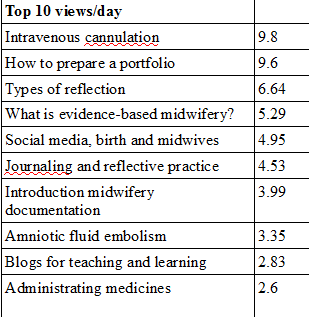
However, the number of views isn't necessary helpful because you would expect the longer a presentation has been published, the more views it would receive. So to get a better sense of what presentations are more popular, I divided  the views of each presentation by the number of days it had been published to find out how many views a day each presentation had received, in Table 2.

Table 2. Top 10 views per day


Which presentation is most useful?
Views are one thing, but what I am really interested in is how useful my presentations are to the wider community. To measure that, I have looked at the total number of downloads of each presentation – my 10 top download loads can be seen in Table 3.


Table 3. Top 10 downloads 

As with the total number of views, the total number of downloads is skewed by the number of days each presentation has been published. Therefore, I looked at the number of views of per download, with the theory that the smaller the number of views per download, the more "useful" a presentation is. In my mind, a presentation that has 1000 views with 10 downloads is more “useful” than a presentation with 10,000 views and only one download.

Table 4. Top 10 must useful presentation (number of views per download)
You will see with both views and downloads that the picture changes a little when you drill down to views per day and views per download. For example, 'My midwifery philosophy' is in the Top 10 list for most views, but it is 'Introduction to midwifery documentation' that is in the list for most views per day, which is arguably the more accurate measurement. That being said, the presentations that were in all four lists were, which makes them, in my mind, my most popular and useful:
  • Intravenous cannulation
  • Amniotic embolism
  • What is evidence-based midwifery?
The topics of presentations that appeared in both of the two top views lists were the above, plus:
  • How to prepare a portfolio
  • Journaling and reflective practice
  • Types of reflection
  • Social media, birth and midwives
The theme starting to emerge here is reflective practice and midwifery. This surprises me on the one hand because I would have thought that people, especially midwifery students, would be able to access information about reflective practice from textbooks and course materials. On the other hand, reflective practice is a core principle of midwifery education, so I am making an assumption (but have no proof) that a lot of people accessing these presentations are midwifery students or involved in education.

What does this tell me?
To be honest, I cannot conclude anything much from this exercise because of the small numbers. However, it is interesting that my most popular presentations have a midwifery focus, as opposed to a more general teaching and learning. 

The questions I am left with are:
  • Does the number of views make a presentation more popular, or number of downloads?
  • Who are the people downloading my presentations?
  • Why do people download presentations?What happens to the presentations?
  • Should I endeavour to meet the apparent needs of the audience based on statistical analytics eg if it appears that clinical topics are most viewed and downloaded, should I deliberately publish presentations that address those topics, as opposed to the approach I have taken thus far which is to just publish presentation I give at conferences, tutorials, lectures etc. 
  • How does open education/access theory stack up 10 years or more down the line, when looking back at the reality of open content?
What is next?
The next activity I plan is to drill down more into the analytics of the downloads to find out what, if anything, that tells me. Depending on the quality of information I find via Slideshare, one idea worth exploring may be to contact the people who downloaded my presentations with a short survey to find out more about the whys and wherefores.

Do you have a Slideshare account? What are your most popular or most viewed presentations? Is there any other information I should look at to inform my research? Have you ever downloaded one of my presentations? Why, and what did you do with it?  


Saturday, April 15, 2017

My PLE - reflecting on the last 10 years

About 10 years ago I became very interested in the use of social media for personal and professional teaching and learning, as well as development and networking. Over the years, as a clinical midwife, midwifery lecturer and eventually instructional designer and staff developer, I have charted my use of online technology and changes in my personal learning environment (PLE). I am just starting a project where I am looking back on the last ten years of open access education and all the concepts that interlink. So it's timely to reflect back on the evolution of my own PLE over the last 10 years.

I tracked my use of online technology for teaching and learning from 2008 to 2011. I haven't posted about it since then, probably because my job changed from working in education to industry, which raises an issue about relevance and applicability that I will come back to later.

2008

In 2008, my blog and e-portfolio (which was hosted in a wiki) was the central point of my PLE, with tools such as Delicious, Wikispaces, Wikipedia and RSS hovering around the edges. I was talking about my blog being the central point of my PLE where I was doing all my thinking, recording and analysis, which resulted in outputs which I displayed in my e-portfolio. However, there was no sign of Facebook, Twitter or other social media tools.


2009
2009 saw the appearance of Facebook, Twitter (more prominent than Facebook), and the virtual world, Second Life.
 My blog was still central but stating to drop off because of time constraints. Slideshare and Youtube were used heavily as alternative places to find information for my teaching, as well as display and share content.

2010


The comment I had to make in 2010 was that my use of tools depended on the work I was doing. For example, Second Life had dropped from the PLE because I was no longer using it in my work. But that in itself is telling, because if it was worthy of use, I would have continued to use it even after my Second Life project had completed. Other tools had dropped off just because they were no longer available such as iGoogle and RSS. Facebook was growing in importance, as a means of networking and sharing information, and I was using tools like Animoto and Screenr to produce content for teaching and so on. I was also using wiki in various form to facilitate online collaboration. 

2011
 

The last analysis of my PLE was in 2011 when I felt that my core tools remained much the same ie blog, e-portfolio, Facebook, Twitter, Slideshare, Youtube, Skype. However, the number of tools had reduced and I concluded that if a tool wasn't simple and intuitive, then I would not use it.


2017

As I reflect over the last six years, I see that there are two major changes immediately noticeable.
  • My PLE has divided, like cell mitosis into two domains: desk top computer/lap top and mobile phone. As you can see, there are tools and activities that cross both domains such as Facebook, LinkedIn and Skype. But, there are other tools and activities that I use specific to a particular domain, not necessarily because they cannot cross into the other domain, but I choose not to use it. For example, I don't use Dropbox on my phone because it's a tool I use mostly for work; as my phone is my personal phone, I don't access work materials on it.
  • The second big change is that Facebook is now the hub of my PLE, with my blog, Twitter, Instagram and LinkedIn integrated into it. This is a complete change from before when my blog and wiki e-portfolio were the hub. I do not use wiki at the moment, and LinkedIn now acts as my e-portfolio.
As tools, apps and platforms have moved in and out of favour, there are a few that have remained my 'tried and true' favorites such as Slideshare, Flickr and YouTube.  I think this is testament to their usability, compared to other platforms that have been 'sparkly' in the short term but have faded from favour. But the range and use of tools may also reflect my own job. For instance, now I am not teaching, I am not using the tools that helped me to develop content. Similarly, BlackBoard and BlackBoard Collaborate are only in my PLE at the moment because that is where/how my MBA is being delivered.

The other thing that has changed, but might not be quite so obvious to people passing by, is that there is a lot less blurring of use across the platforms. For the most part each tool and platform has its specific target, audience, or place in my learning; Linkedin and Slideshare has professional uses; Facebook is mostly personal; Instagram is where I connect with the local Canberra community. Skype and YouTube  are the two main tools that cross over both personal and professional spaces. And as for my blog, I have just started blogging again after a time away, so not sure how that's going to go.

This is the start of a bigger project where I want to look at how my content has been accessed and used over the last 10 years, in relation to open access and open education. I think its going to be a very interesting journey.

How has your PLE changed over the years? Do you still blog or use wiki? How big a place in your learning does Facebook play? What the latest new tool that has come out that you love? Is the PLE such a thing, or just  trendy term that we used back in the day?

PS: If you're interested in tracking your use of social media and online tools over the years against the global trends, have a look at Jane Hart's Top Tools for Learning Lists which she has been amalgamating since 2007. 

Monday, October 12, 2015

5 reasons for integrating social media into your professional role

I have just been asked to comment on my use of social media in my professional role as Professional Officer at the Australian College of Midwives for a Japanese magazine, of all things! This has got me reflecting on my professional use of social media, and what lessons I have learned that I would like to pass on.

I have significantly altered my use of social media since taking on this visible, national role especially compared to when it was my job to promote the use of social media in education previously. To be honest, I am not half as open as I was because of the issue of professional online identity. Nonetheless, I believe social media can be a very effective tool in the working life of professionals including those who work at higher levels in companies or organisations, or have very public profiles.

Here's 5 reasons why I use social media in my working life, in no particular order.


1. Carry out environmental scans
I find it very useful to carry out a scan of social media because I pick up on the latest news and trends, and find out what issues are being talked about often before they have hit main stream media. This is especially useful when I am trying to find out what our members care about.

Environmental scanning also means there is the potential to pick up criticism of the organization I work for, or the work we are doing. This can be quite confronting and it is very hard not to take personally. But it does allow me to reflect on what the organization and I are doing and make changes accordingly, which hopefully improves people's understanding and engagement with our work.  

I know this sounds a little sneaky, but online environmental scans also allow me to see what other organizations in the maternity space are doing.  This may show up potential opportunities for collaboration and joint work. It may also give me the heads up about issues that we are falling behind on and need to address.

2. Network with influencers
In every day practice, it is often not possible to meet and talk to key people that influence thinking, policy or outcomes that impact on the organsation or profession. Politicians, policy advisers, journalists, senior executives can all be difficult to access for one reason or another. Following and engaging with these people via social media can be hit and miss at times, but at the very least I can see what they are interested in which may give me clues about how to focus my interactions with them. And if I am lucky enough to have them follow me, I can be very strategic about what I post in order to inform them about issues I want to highlight.

3. Make individual connections
In my role I am expected to be outgoing and talk to people about the College, midwifery and so on. But I am not a naturally extrovert person in the face-to-face setting and sometimes I do find it difficult to start up conversations with complete strangers. What I have experienced is that by posting personal information about me, people see my "human" side which makes me more approachable. This gives me a hook into conversations with people which I  use to make personal connections before I progress into discussions about professional/business topics. For example, I have been posting on Facebook lately about my poor gardening skills, and at the recent ACM conference I had people come up to me and ask about my tomatoes which has been a fabulous ice breaker for us both.

4. Access the crowd knowledge and skills
One of the most exciting use of social media in my job has been crowd sourcing ideas, information, resources and volunteers to become involved with College activities. We do use more traditional methods of recruiting volunteers for projects that are successful but social media facilitates immediacy of response and is a lot less bureaucratic. It's when I am doing work like responding to a submission, that has to be submitted yesterday, that I find real advice or information so useful to glean via social media. And we've even had people join the College to do projects that they've heard about on Facebook etc - doesn't get any cooler than that!

5. Reduces professional isolation
There's much talk in health about the isolation of health practitioners working in rural and remote areas. But I think practitioners can feel equally as isolated living in urban areas, and that geography isn't relevant in some cases, but rather it is the role that can make one feel isolated.

In my case, there are not many midwifery  policy advisers in Australia so I have to look further afield for the support that I may need that is specific to my context such as the #WeMidwives community. Or, look at connecting with professionals with similar roles but in other industries in LinkedIN.

Do you use social media in your professional role? What tips would you pass on about integrating SM into your work?   


Thursday, October 1, 2015

Ditching my e-portfolio for LinkedIn


I have been reviewing my online spaces and how I use them. One of the decisions I have made is to move from the e-portfolio that I have been maintaining on Wikispaces to Linkedin.

What is the advantage of using open software for e-portfolio?
I kept my e-portfolio on an open wiki from about 2008-2012. I really enjoyed the freedom that it gave me, allowing me to design my content in which ever way I wanted.

It felt very exciting to be modeling to people what can be achieved and I had lots of inquiries and comments about the legalities of having my work openly available over the years. I have written about my experiences, and the challenges of presenting my work as a practicing midwife, especially around the issues of confidentiality of patient/client information: Making practice transparent through e-portfolio (Women and Birth, Vol. 26, Issue 4, e117–e121).


Why I am making the move to LinkedIn
The disadvantage to using the wiki is that I don't feel it has the "professional look" that other platforms such as Linkedin has. The wiki was perfect as a "sandpit", especially in my role as educator. However, now I have more of a corporate role, I feel LinkedIn is a more appropriate space to highlight my professional activities.And as well as providing an e-portfolio capability, LinkedIn allows me to connect with other professionals and provides access to news and information relevant to my work.

 
Downside of LinkedIn? 
For the most part, LinkedIn provides appropriate space for my work. It does have constraints that I have to work within that my wiki never had, which is a little frustrating at times.  And I don't like the vertical structure which forces readers to be forever scrolling down to get to information. However, I do like the guidance it provides which I think is really useful to people who are new to e-portfolio. And the ability to upload evidence of work into LinkedIn makes the platform more than a glorified CV. 

Backup?
One issue that I need to explore is how to back up my work, or download it. I don't know what ability LinkedIn provides to ensure I do not lose my material.

Do you have a LinkedIn account? How do you use it - for professional networking, e-portfolio, or another purpose?