Showing posts with label sustainability. Show all posts

Saturday, November 14, 2015

Community garden plot all planted up for the summer


I am extremely excited to have taken procession of a plot in a community garden. I got my poor hubby to dig it over and we've prepared it with compost, horse manure and mulch, and are all ready to go with growing stuff.

We've planted:
  • tomato plants grown from seeds and 2 tomato plants that we've bought from a nursery;
  •  2 cucumbers;
  • 2 chilli plants we've bought, and 1 plant I've grown from seed;
  • 2 egg plants;
  • 2 melons;
  • 2 capsicums; and
  • a lavender bush to attract bees.
The plot gets a lot of sun so will need lots of watering in the summer months. But we're noticing that we have a lot of worms in the soil which is a good thing, and the chilies and capsicums are already thriving.

Do you have any tips on how to maintain a small, raised garden bed?

Monday, October 26, 2015

Experimenting with an inground compost


One of the disadvantages of living in a flat, as opposed to a house with a garden, is that I cannot do anything useful with my food scraps. Now I have my little plot in the Kingston community garden, I can go back to saving food scraps for compost.
 One of the gardeners in Kingston has recommended that I try to develop an in-ground compost system. This requires "planting" a plastic container in the plot, with its bottom removed, like this upside down ice cream container. It needs a lid that can be removed. Waste food then goes into the container. Hopefully, worms make their way to the food  and break it down, and then the material is placed around plants to nourish them. 
You can buy the containers from places like Bunnings. I am using an ice cream container but I think it is going to be too small and I might need to progress to a larger container.

Have you ever used an in-ground compost system, or worm farm? How did you get on? 


Saturday, March 22, 2014

Two sides to every gardening story

As far as I am concerned, one of the great mysteries of life is how everyone and anyone can grow the most wonderful vegetables in the most unusual pots and challenging locations but I can't!!! 

I know all about vertical gardening....


                                                                                                                   growing vegetables in pots...


making the most of a balcony...

But do you think I can manage anything similar?!  The answer is NO!

I lost track how much I spent this spring on pots, plants and compost, with the view of feeding Africa from the produce I would grow on the balcony of my flat in Canberra. 

This is all I managed....3 tomatoes...and 4 capsicum the size of gob stoppers!


Honestly...I give up!

Thursday, November 1, 2012

How can I keep veggies growing in pots hydrated during Canberra's hot summer?

I am living in a flat on the 6th floor of an apartment in Canberra. Luckily we have a really decent balcony, so I should be able to grow some veggies in pots this summer. Apparently the summers in Canberra get quite hot so I thought I'd have a go at growing chillis, capsicums and cucumbers - all plants that were not so easy to grow when I was living in Dunedin.

The only snag is that I will be away for periods of time during the summer and am concerned about how I can keep the plants hydrated, so they do not die while I am away.

Any suggestions about how I can manage this problem?


Thursday, March 22, 2012

Lesson I have learned about growing veggies in pots this year

I have just come to the end of my third year of experimenting with growing veggies in pots. To be honest, the main lesson I have taken away from this year and previous years, that it just isn't cost effective. This is especially as I am only just down the road from a fabulous farmers' market where I can stock up with fresh veggies every week. But having said that, I get a tremendous amount of pleasure out of the whole process of gardening, so from that point of view, the pots have been very successful this year.

What worked well?
Beetroot grew well. They didn't get very big but that suited me for bottling. Carrots grew well too but I had to work hard to thin them out so they had enough room to get to a decent size. Broccoli and cauliflower appear to do well in pots except they were decimated by bugs and caterpillars. And I can only get about one plant to a pot which makes it extravagant pot use. I also had a very respectable crop of cucumber which I grew in pots in my porch. As for herbs, I have done well with both rosemary and mint in pots.

What didn't work well?
I must be the only person in the world who cannot grow pumpkin. I had one plant in a huge pot but it still came to nothing. I only managed to get one zucchini from three plants and my lettuce were useless...they were very small and curled in on themselves.

What I am going to try next year
I have just planted some onion seeds so it will be really interesting to see how they do. And I am just trying to think what to put in my big bath...any suggestions?

Have you tried to grow veggies in pots? How did you get on? What veggies did you find do the best in pots?

Monday, November 28, 2011

Slightly potty in 2011

Over the last couple of years I have been playing around with growing vegetables in pots. On the whole my experiments haven't been terribly successful and I have found it rather a waste of time growing dwarf vegetables such as dwarf peas, beens, carrots etc because the yield is so small. We have an excellent farmer's market in Dunedin, so it's more cost effective buying my veggies there. Needless to say, this year I've turned a lot of my pots back to flowers again.

However, I am growing cucumbers in my porch, and trying normal size carrots and beetroot in my big pots. I'm also trying out cauliflower and broccoli in pots. I think they'll be too big for pots but as I have some spare seeds that need using up, I thought I'd see how they go. I am not going to bother with tomatoes this year - they always get battered by wind this time of year in Dunedin and never do very well.

As for the flowers, I am growing dahlias as a tribute to my father's parents and their son, my Uncle Fred who died last week and is being buried today. My family used to live on a farm and I remember very clearly the large number of dahlias that my gran used to grow in the farmhouse gardens.


The highlight of my year is using my old bath for the first time for growing a mix of flowers and veggies. I have sweet peas, lettuce, fuchsia and lebelia which should be an interesting mix. I have also put the old bathroom toilet and sink in the garden and am growing flowers in them.


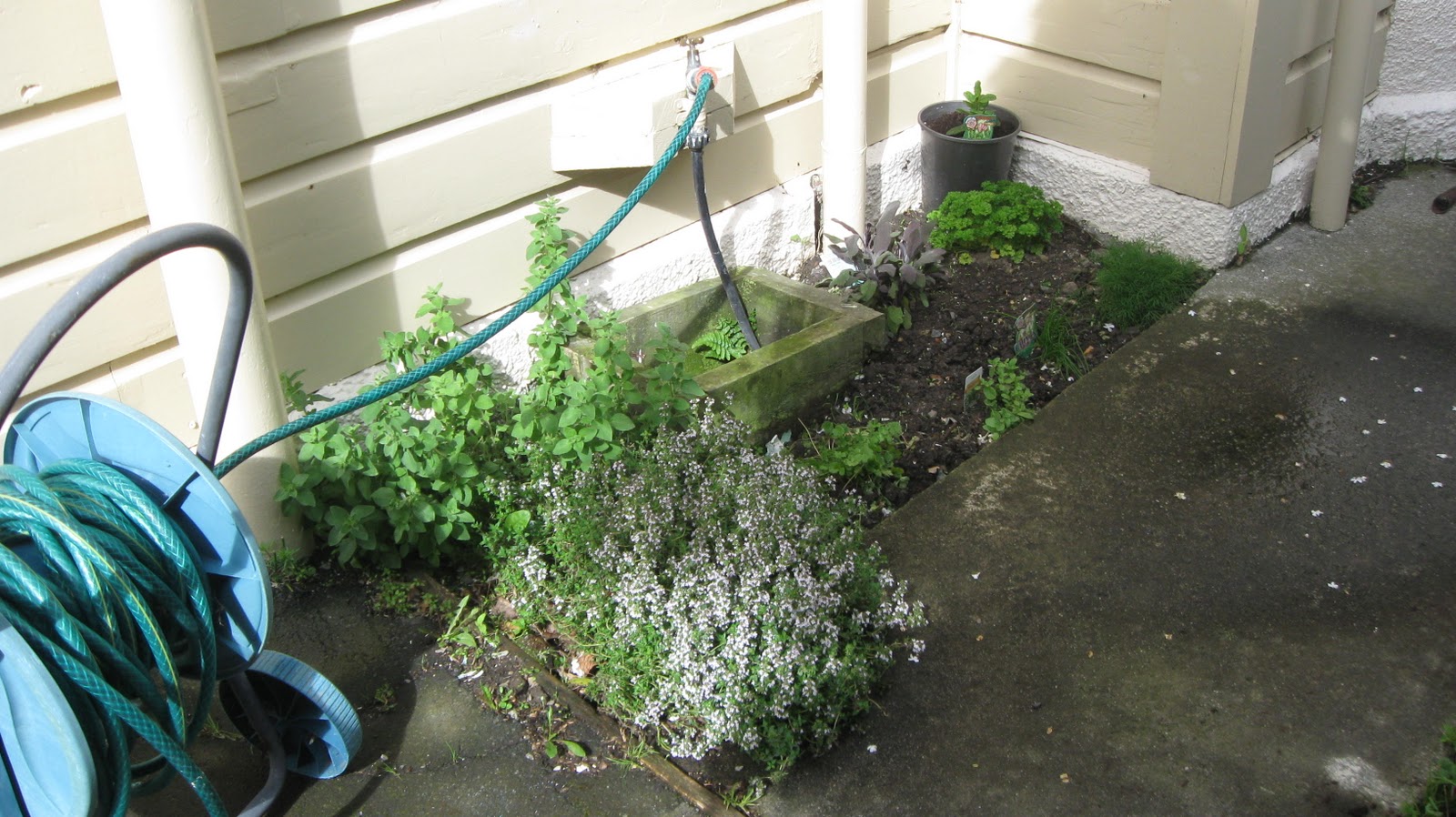
The other highlight is the development of my herb garden. Two years ago my husband "threw" some thyme into a damp, shaded corner that grew weeds and not a lot else. Last year I noticed that the thyme was doing really well so I added an oregano plant which I had been given. I didn't think it would survive but this spring both herbs were growing really well. So I have added parsley, coriander, chives, mint, rosemary and sage. I'm hoping they take off as well.


Have you had any success growing veggies in pots? What tips would you pass on to me and anyone else doing the same thing? What other herbs would you suggest I put in my herb garden?

Wednesday, August 31, 2011

Sustainability of the Virtual Birth Unit in Second Life

Deborah Davis and I are writing an article that focuses on the sustainability of midwifery teaching initiatives in Second Life and we hoped that we could have a chat with anyone who has heard about the SLENZ virtual birth unit. We are interested in anyone who has visited or used the Birth Unit (even if you used it to inform the development of your own).

We have put a couple of questions together but we would love to chat in Skype or by phone with you if possible.

1. How did you find out about “Te Wahi Whanau”, the virtual birth unit on the island of Kowhai?
2. What is your interest in VBUs such as this?
3. Do you/did you use this particular VBU (or any aspects of it)?
4. How do/did you use this VBU? What aspects of the VBU do /did you use?
5. What are your experiences of using the VBU?
6. Did you make a copy the VBU?
7. If so, for what purpose?
8. Do you know of anyone else who might be using this VBU that we could contact?

Please let me know if you have any feedback for us.

Saturday, March 26, 2011

Saying goodbye to my old bath

When we moved into our house back in 2001 I wasn't very impressed with it. It was an old 1920s villa and was a rental property. It had been run down, and we were pressurised into taking it because there was a shortage of rentals that were suitable for a family like ours. We eventually bought the house off the landlord a few years later, and have been renovating it ever since.

One of the things I feel in love with over the years was the bath. I am 99% sure it is the original bath. It is solid steel; much deeper than a modern bath, and so long I can stretch right out in it. I have had many happy hours in it relaxing, reading, eating chocolate and drinking wine.

But it has to go. It needs renovation and with the money it would cost us to renovate it, we pretty much can replace the whole bathroom suite.

So today it's going - as long as we can actually shift it, which will take at least three very strong men - and I'm about to enjoy my last, long soak. It's being replaced with a horrible, plastic modern bath which doesn't look half as romantic.

And as for the old bath, assuming we can get it out of the house in one piece, I will either sell it or use it in the garden for growing veggies.

Saturday, December 4, 2010

Otago Polytechnic: a living campus

A couple of years ago, Otago Polytechnic set up a project called The Living Campus. My understanding is that the idea behind the project is to make the campus an example of sustainable practice, integrating learning experiences for students and developing community vegetable production.

I am not sure if the project is meeting its original aims but I have been enjoying watching the vegetables and flowers grow - the campus is currently looking really exciting and colourful.

At the moment there is a person employed to grow vegetables which are then available for anyone to pick, including members of the public. A couple of days ago I picked a meal's worth of broad beans which was the first time I have eaten fresh broad beans in many, many years.


I am not too sure how sustainable the gardens are. As far as I can tell, Otago Polytechnic is putting in all the funding and effort. I haven't seen any community activity going on. What I would like to see is some sort of reciprocal arrangement...if you take away vegetables, you replace them with seeds or plants. I've got some spare tomatoes plants which I'll take into work next week.

What I'd be really interested in is setting up a gardening club at Otago Polytechnic that meets in a lunch time...maybe that will be one of my projects next year. I'm just wondering if there'd be any interest.

Saturday, October 23, 2010

Growing beetroot in pots

I bought some beetroot seeds (Red Globe) last year but never got around to planting them because I didn't have room in my garden and thought they'd be too big to plant in pots.

But I have been reading a book called "Organic crops in pots" by Deborah Schneebeli-Morrell which maintains it is quite possible to grow beetroot in pots. Deborah maintains it is possible to grow beetroot in containers 30cm (12in) high by 35cm (14in) diameter. What she does not say is how many beetroot you can expect to grow in a pot this size.

I have decided to give it a go but it will be a guess as to how many beetroot I can grow. I'll report back how I do.

Do you have any idea of any blogs or websites that give specific information about how much room vegetables need to grow, especially in containers?


Image: 'Gastrocast #41'
http://www.flickr.com/photos/86571141@N00/85684471

Monday, October 11, 2010

Does education and gardening mix?

I have been having a look at the Internet to see what blogs are about that deal with growing vegetables in pots. As far as I can see, there are heaps of blogs about gardening but few address the nitty gritty issues and questions that I have, such as how many beetroot should you sow in a pot of a certain dimension. And certainly very few that are based in New Zealand/Australia.

So...long story short...I have decided to document my experiences of growing veggies in pots, making sure I record very explicit information for people who doing the same thing as me...trying to raise veggies in an urban garden with minimal space.

Up to now, I have been really lazy and posted my gardening posts on this education blog because I cannot be bothered with having a separate blog. But I am wondering if this is a good idea. So I would like to ask your opinion about my options.

1. Keep using this blog for my personal and gardening posts, just as I have been doing up to now.

2. Start another page attached to this blog...next to the tabs above...About...Consultancy...Contact...Consultancy...Garden

3. Start a completely new blog.

What do you think is the best idea?

Thursday, October 7, 2010

More experimenting with growing veggies in pots

Having decided tomatoes, lettuce and zucchini grow well in pots, I am going to try to grow a few more veggies in pots this year. I have just planted broad beans, and I'm going to try spring onions, marrows, basil, cucumbers and onions. I'm also going to give strawberries another go even though I didn't have much success last year.

In the garden, I'm going to grow cauliflower and broccoli again - they did really well last year planted in amongst my flowers. I've got nice compost that we've made that I'll be able to use this year. And also have some sweet pea and snap dragon seeds I can plant from last year's crop.

This year I'm going to grow veggies from seeds so it will be interesting to see how this goes. I spent the weekend clearing the garden of weeds and planting the seeds in propagating pots.

But the highlight of the weekend was discovering we have a blackbird pair nesting in a rosebush. The nest is at eye level so we have a discreet view of what's going on. I'll be able to sit in my porch with my hubby's binoculars and watch the comings and goings without upsetting the birds. We just have to keep an eye on the cat and make sure she doesn't try to get to them.

Saturday, October 2, 2010

My urban garden 2009: success and failures

It's spring here in New Zealand and those of us with gardens are out and about planning for the coming year. But before I can think about this year, I really have to reflect back on what worked and what did not work last season.

Successes
I had great fun growing cauliflower and broccoli amongst the rose bushes and in the 4 foot square garden that I have at the side of my house. They were by far my most successful veggie. The broccoli was fantastic because they kept growing even after I picked a few shoots. The only snag was...when I froze the broccoli, all the little green shoots broke off which just left me with big stems. So I don't think I'll try freezing them again.

The only tomatoes that did well last year (because we had terrible weather in December and January) were Sweet 100 which grew like weeds, but only once I brought them inside our little porch-way.

I also grew a nice zucchini crop in a pot, which did really well in a warm corner around the back of the house.

Failures
I experimented with growing potatoes in bags which didn't do as well as I would have liked. I got about a meal and a half from 4 seed potatoes in a 40 litre bag which just was not cost effective. Whilst they tasted absolutely delicious and were great fun to grow and harvest, this is not something I am going to try again.

I grew some very nice tasting apple cucumbers, but they came very late in the season. I also grew some mini marrows which rotted before they could be eaten, and when we tried eating them, they tasted horribly sour. The few cabbages I grew got eaten by caterpillars. I didn't do very well with strawberries, with just one or two worth eating. And as for rhubarb...I can't grow it for love nor money.

What I really need is a little garden I could borrow from someone so that I can really get stuck in, instead of mucking about with pots. I'll have to ask around locally to see if anyone has a small garden they would let me use for growing veggies.

Saturday, February 20, 2010

Mixed success with my urban garden

This year has been a little experiment to see what vegetables I can grow in my very small garden, and what I can manage to grow in pots and bags.

Failures
I have discovered I cannot grow rhubarb for love nor money, and my spinach got eaten before it came to anything. I have three tubs of strawberries that have produced no more than half a dozen very small fruit. And my tomatoes, both in the garden and in tubs, have grown into huge bushes with lots of flowers, but no sign of any fruit - I am hoping that we have a sunny Autumn to encourage them to come on.

Successes
I have one pot growing a courgette plant and that is doing really well with lots of fruit- I would need to grow another two or three pots to get a decent number of courgettes, which I will do next year. My potatoes in bags are shooting up all over the place, so I am hoping for a good yield from them.

My major success has been the broccoli that I have planted into between flower plants - they have taken over what little garden I have, and it looks like I will get a crop that will keep my husband and I going for quite a few weeks.

It has been an expensive exercise growing vegetables in pots, by the time I bought soil, compost, pots and so on. No doubt it would have been much cheaper to go to the farmers' market every Saturday and get my vegetable supplies there. However, it has been great fun watching the plants grow, and I am a bit like Prince Charles......I go out and talk to the plants every evening and tell them how beautiful they are...to try to encourage them to grow more....my kids think I am turning into a dotty old woman!

What do you find grows well in pots, and what should be kept in the garden?

Tuesday, January 5, 2010

My urban garden

One advantages of being settled in Dunedin this year is that I can spend some time playing in my garden. As I have said before, I do not have much room in my garden so I have spent the last few weeks experimenting with growing flowers and vegetables in pots and bags.

What I have tried to do is use pots for growing flowers, and plant vegetables in the flower beds. My hubby isn't too impressed because he says the place looks untidy, but hopefully he'll change his mind when we have fresh veggies for tea.

I am growing strawberries, potatoes (in bags), cucumber, marrow, rhubarb, silver beet, cabbage and broccoli.
I also have some tomatoes growing, but they have been badly affected by some very cold wind we have been endearing over the last few weeks. So I have had to rescue them, put them in pots and keep them indoors for the time being.

I'm not saving money by doing this because I have had to buy a lot of pots, compost and potting mix. But what I'll try to do next year is grow my plants from seed instead of buying them as plants from the garden center.

Needing advice
I have just found some Maori potatoes and yams sprouting in the bottom of my potato bucket and am thinking of trying to grow them too. Any advice of the best way to do this?

Monday, October 26, 2009

Can someone lend me their garden please?

Every spring my hubby and I have the same argument about the garden. I want to have a go at growing vegetables but the truth of the matter is we just don't have enough room. I grow a few tomatoes, but I'd really like to have a decent allotment or something like that.

I understand there are a couple of community gardens in Dunedin, but I'm not too sure what they entail, and I'm too selfish to want to grow a lot of veggies that then get pinched by the 'community'. I also know that Horty Kim is running a permaculture garden at Otago Polytechnic, so I need to go and have a look there.

But what I would really like is for someone to 'lend' me a patch of their garden that I can turn into a veggie patch. If you have a garden that you're not using and would be happy to let me potter around in it, please let me know as soon as possible.

Saturday, May 23, 2009

Flexible learning, eMentoring, cultural differences and sustainability

Flexible learning has been a theme for me this week as I have been progressing with my eMentoring project and also thinking about the Flexible Learning Course I am taking at the moment. One aspect we have been asked to consider is cultural inclusiveness. How accessible is education to people of different cultures and how can educational services be improved?

eMentoring and indigenous and Torres Straits people
To cut a long story short, one of the remits of the eMentoring project I am managing for Aged Care Queensland (funded by the Dept. of Health and Aging) is to recruit indigenous and Torres Straits people as eMentors and eMentees. This is because they are identified as a group of people who require support in the workplace, but do not get it as much as they should. eMentoring is part of an ongoing strategy to recruit and retain more indigenous and Torres Strait people in the aged care workforce.

However as yet, I have been unable to recruit any one from that cultural group into the project.

Barriers to eMentoring
I went to Cairns this week and spoke to several people involved with providing education and employment services to indigenous and Torres Strait people and asked them why they thought the eMentoring project has not attracted participants from that cultural group. The main issues were lack of access to the Internet, especially in remote areas such as Thursday Isalnd. Internet coverage is very unreliable in rural/remote areas. Lack of computer skills was one of the other main issues.


Cultural considerations

But things were a little more complex than the usual lack of access and skills. Other feedback I receieved was:
  • Indigenous people are very unlikely to engage with any form of electronic communication because they much prefer face-to-face communication;
  • Building a rapport and feeling of trust is vital when working with indigenous people -this would be very difficult with computer-mediated communication (CMC);
  • Literacy levels are very low in indigenous communities so text-based communication would be problematic;
  • Communication tools such as video and audio would not engage indigenous learners because of the complexity of the technology;
  • People would not want the shame of 'failing' if they could not get their heads around eMentoring;
  • Partners could put up barriers because of jealousy, especially if the mentors/mentees were of the opposite sex;
  • The lack of privacy due to living in a close community could prevent people using community computers.
Need for mentoring
Having said all that, the people I spoke to emphasized the great need for mentoring, especially for indigenous people entering the workforce or moving to a new job. It was felt that face-to-face mentoring was by far the most desirable mode of delivery. And there would need to be intensive work done to build rapport and trust (5-6 meetings are required before trust begins to form), especially when the indigenous person begins a new job or education program.

www.flickr.com/photos/26015483@N00/2222131958


Making assumptions
I am not altogether sold on the idea that indigenous people would not engage with video or audio technology. If it was provided and made very easy to use, people may find it a much more user-friendly mode of communication, especially as their culture is of oral communication.

Somehow I feel very uncomfortable with the feedback I received. It felt to me as if indigenous people are being prevented from having the opportunities to engage with technology because a number of assumptions have been made. Sure, we need to pay considerable attention to the feedback I have discussed, and make sure people get the face-to-face support and education they need. Yet at the same time, I also think we should do all we can to provide opportunities for online learning and networking for those who are interested. If we do not provide alternative modes for learning, how can people say whether they like them or not?


Sustainability
I have become more and more convinced that small rural communities need to work together to provide access to computers and Internet, as well as training. As educators, we need to think about how we can hook into local libraries, schools and learning networks and collaborate to provide education opportunities to the wider community. So, for example, if I go to Chinchilla to provide a blogging workshop to staff in aged care I should make sure it is open to the whole community. This increases flexibility of learning, and it also goes some way to address the issue of sustainability.

This may mean that we have to do things for 'free'
which could prove to be a stumbling block for administrators and accountants. But I truly believe that thinking about the 'greater good' is one way of dealing with flexibility and sustainability in education.

I would love to hear from anyone involved in providing education to indigenous communities. What would be your advice to me about how I can engage indigenous people in my eMentoring project?

Friday, May 1, 2009

Midwifery, sustainability and International Day of the Midwife 2009

One of the themes that has shown up in the program for the virtual International Day of the Midwife 2009 is sustainability.

Carbon footprint
In one session, Lorna Davies is talking about carbon footprint. To be honest, I am not sure where Lorna is going with this, but you can find out more about her thoughts on the sustainability wiki that she has set up: EcoMidwife.

Sustainable parenting
The second session is by Anna Hughes, who is a lecturer at Otago Polytechnic, Dunedin. Anna has recently written two blog posts about sustainable parenting from a mother's point of view.

Nappy-free babies
Her first post is about raising a nappy-free baby. I have to say that up to now I have thought that parents who do this are stark, starring mad. But I really enjoyed Ann's explanation of how to tune in to a baby's behavior, and I think this post is an excellent resource for parents wishing to pursue this model of parenting.

Sustainable midwifery practice
In the second post, Anna challenges midwives about the things we can do to support sustainable parenting. I agree that the two biggest things we can do to support sustainability is to carry out more home births, and encourage breastfeeding. As a hospital and home birth midwife, I know I use far more commodities in hospital because I don't have to pay for them, and there is a never-ending supply of plastic and paper.

If you would like to know and join in the discussion about sustainability, have a look at Lorna's wiki and Anna's blog, and join us on International Day of the Midwife on May 5th.


Image: 'medical waste' GregPC
www.flickr.com/photos/55236839@N00/552123360

Wednesday, December 10, 2008

A tale of two cabbages

After a fair bit of nagging, my husband finally relented and has allowed me to experiment and grow a few vegetables in my urban garden.

Now, to be fair to my husband, I am known for my wild ideas about the garden that I never follow through. And I always leave him to clear up the mess. So this is why I had to prove to him that I could be responsible and not cause him yet more grief, garden-wise.

I've planted a few lettuces, parsley, tomatoes, spinach, celery and two cucumber plants. I've had my first harvest of lettuce- three leaves - don't laugh, it was enough for one salad!

But sadly, the cucumbers have come to grief.

The other success story is that we have made our own compost and put it around the tomatoes and roses. But the dog has eaten a lot of it, so I am not sure what good it has been!


What are you most successful at growing - flowers, vegetables or weeds?

Thursday, November 20, 2008

Sustainable Christmas

I just looooovvvvveeee Christmas lights! I would be one of those mad people who have lights all over the house and enter competitions. But my hubby won't let me - he says we can't afford the electricity bill.

Solar lights
In a bid to be environmentally friendly and do my bit for a sustainable Christmas, I bought some solar lights that you plant in the garden. But hubby won't let me put them in the garden because of the danger of them being nicked. So I've got a lovely pile of boxes in my hall way.


I've had my eye on solar fairy lights for some time but they have been extremely hard to come by, and very expensive. But today, I found them for sale in a big local department store and bought a box of 139 lights.

The beauty of these is that I can string them high up on the roof to prevent them getting stolen - or at least, I can get hubby to climb a very tall ladder and string them high on the roof!

So now I'm happy - I can have as many pretty flickering Christmas lights as I like strung about the house without worrying about melting the Arctic ice cap. All I want now is someone to invent one of those big Father Christmas arrangements out of solar lights. If you know where I can get something like it, please let me know.